



Pola Salicka
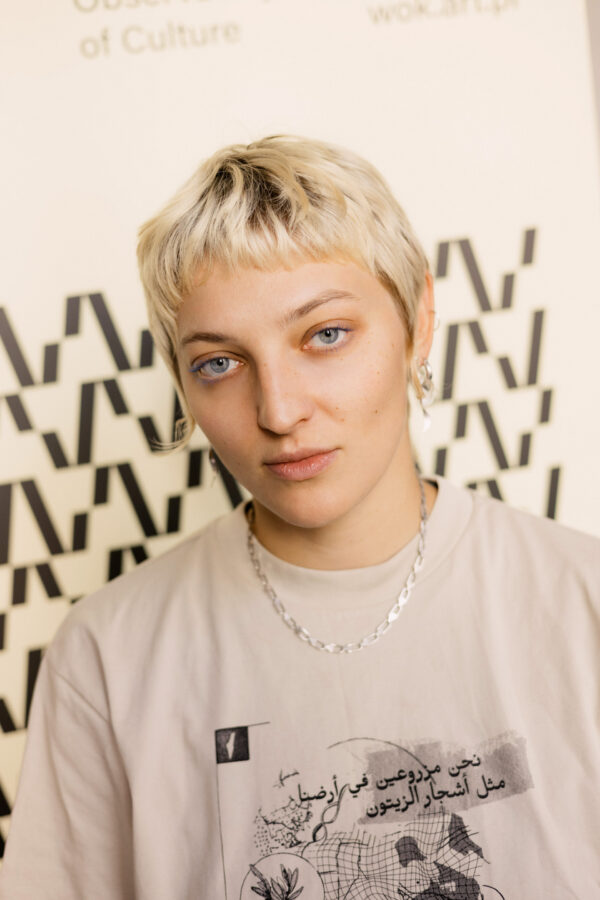
Years of working in collectives, groups and artistic duos have taught me an enormous amount, yet in a way they have also made me ‘dependent’ on the security of shared responsibility, group support and a sense of purpose (because if several people say it makes sense, then clearly it does). I would like the residency to support me in initiating my own projects, independent of current group projects, which require a completely different kind of commitment. Figuring out what I, as an independent artist, can contribute to collaborative work requires space and reflection. I hope this will also lead me to learn how to better manage my commitment to both individual and group work.
I intend to focus on experiments with wild plants, with an emphasis on those associated with the local aquatic environment. From gathering them to shaping them. This is a time for spontaneous, manual activities (dyeing, sewing, weaving, documenting, etc.) that are not geared towards a pre-planned end result, but depend on the cycle of nature and the outcome of successive attempts. In my work with plants, I respect their agency – they tell stories, act as connectors, and provide a sense of being rooted in the world and of belonging. I see the development of a regular personal practice as a tool that supports me in functioning within a city that provides constant stimuli, strengthening my mental resilience and, hopefully, my economic one as well.
I am a designer and artist; my work is situated somewhere between marshes, gardens, bushes, the city’s outskirts and its centre. For years, I have been working collectively at the intersection of art, ecology and climate activism: within the Spółdzielnia KRZAK cooperative (2016-2020), a garden/meeting place in Jazdów, and currently as part of the ZAKOLE group (from 2020) focused on artistic, advocacy and educational activities centred on the wetland at Zakole Wawerskie in Warsaw. I am committed to building community-building practices and spaces that raise our awareness of interspecies relationships and mindful coexistence with others. I create situations, installations, workshops, publications, objects and other forms, often through collaboration and alliances.
I have collaborated with the Museum of Modern Art in Warsaw, the Ujazdowski Castle Centre for Contemporary Art, Jasna 10 Społeczna Instytucja Kultury Krytyki Politycznej, Haus der Kulturen der Welt Berlin, Floating University Berlin, Robida Collective, Osiedle Jazdów, ‘Słonecznik’ Solidarity Cultural Centre, Kuchnia Konfliktu, MAO Ljubljana, Jan van Eyck Academie, Unsound/Ephemera and others.
Residency summary
The three spring and summer months of the WOK residency gave me space and structure I’d needed for a long time. My original assumptions largely held up. Manual work stopped me from second-guessing the significance of what I was doing, from constantly searching for deeper meaning, impact, or economic payoff — instead I learned to just do, to test, and to see what came of it and where it might take me. Simply confirming that my idea for the residency had real value at this point in my life was, on its own, affirming.
I didn’t anticipate how emotionally demanding this work would be. In group sessions led by Agata Nowotny, a former WOK resident, we explored our desires, fears, obstacles, and resources, using somatic, visual, and associative tools to work with imagination and symbolism. Asked to name “the hardest thing I could stop doing,” I wrote my answer without thinking: “stop distrusting myself.” Working on self-trust — a quality without which it’s hard to act, or to hear your own intuition — became the psychological core of this residency for me.
I came to understand that my own artistic practice isn’t just one path among others; it’s a necessity — the foundation I must stand on before I can move toward collective or group work, a way of seeing the world, something that holds me up. To understand this better, I talked with several people close to me from the art world, asking about their own practice: what they do for themselves, what strengthens and develops them, setting aside economics and current projects — how they carve out space for it, what helps. Those conversations showed me how much uncertainty and struggle we share, but also how many different strategies, exercises, and stories we build for ourselves to keep going.
A basket-weaving workshop with Adam Pliszko was one of the most fascinating parts — learning the whole process from start to finish: gathering the plants, drying and preparing them, and finally the weaving itself. Watching and listening to someone so deeply rooted in that process, in his relationship with plants, his love for nature and for the family land he lives and works on, was itself a lesson in a different pace and a different kind of attentiveness.
I’m leaving this residency stronger, and confident I can develop artistic methods of my own. The search has genuinely begun — not as an idea, but as practice — and I feel the pull to keep building this path, whatever purpose it ends up serving. I’m also grateful: for being able to go through this process, for the openness of the other residents, and for the generosity of the plants and people I learned from.
During the residency I worked with: black alder, common onion, yarrow, silver birch, alder buckthorn, greater celandine, bird cherry, wild cherry, walnut, staghorn sumac, common hazel, apple, pear, black currant, flowering quince, border forsythia, Oregon grape, black elder, common lilac, Scots pine, common club-rush, sand sedge, blue-green rush, sweet flag, yellow iris, ribwort plantain, small-leaved lime, and common dandelion.