



The Warsaw Cultural Participation (WCP) Programme


The last city-wide survey on cultural participation in Warsaw was conducted in 2017. Eight years is a very long time for a city as dynamic as Warsaw – all the more so given that it has been an exceptionally turbulent period: the COVID-19 pandemic, rapid technological development (especially AI), as well as the demographic changes caused by the geopolitical situation – all of this has affected residents in their habits and their needs regarding cultural participation. The challenges facing cultural institutions have also changed; they are re-evaluating their identities in the current context and seeking appropriate tools and data to help them navigate.
The Warsaw Observatory of Culture (WOK) has developed a new research approach that will enable a systematic measurement of participation (and non-participation) in culture in Warsaw. In the longer term, this process will support both cultural institutions and local government in making productive use of data – institutions in understanding their audiences, and the city in shaping data-driven cultural policy.
Components of WCP
WCP brings together three components.
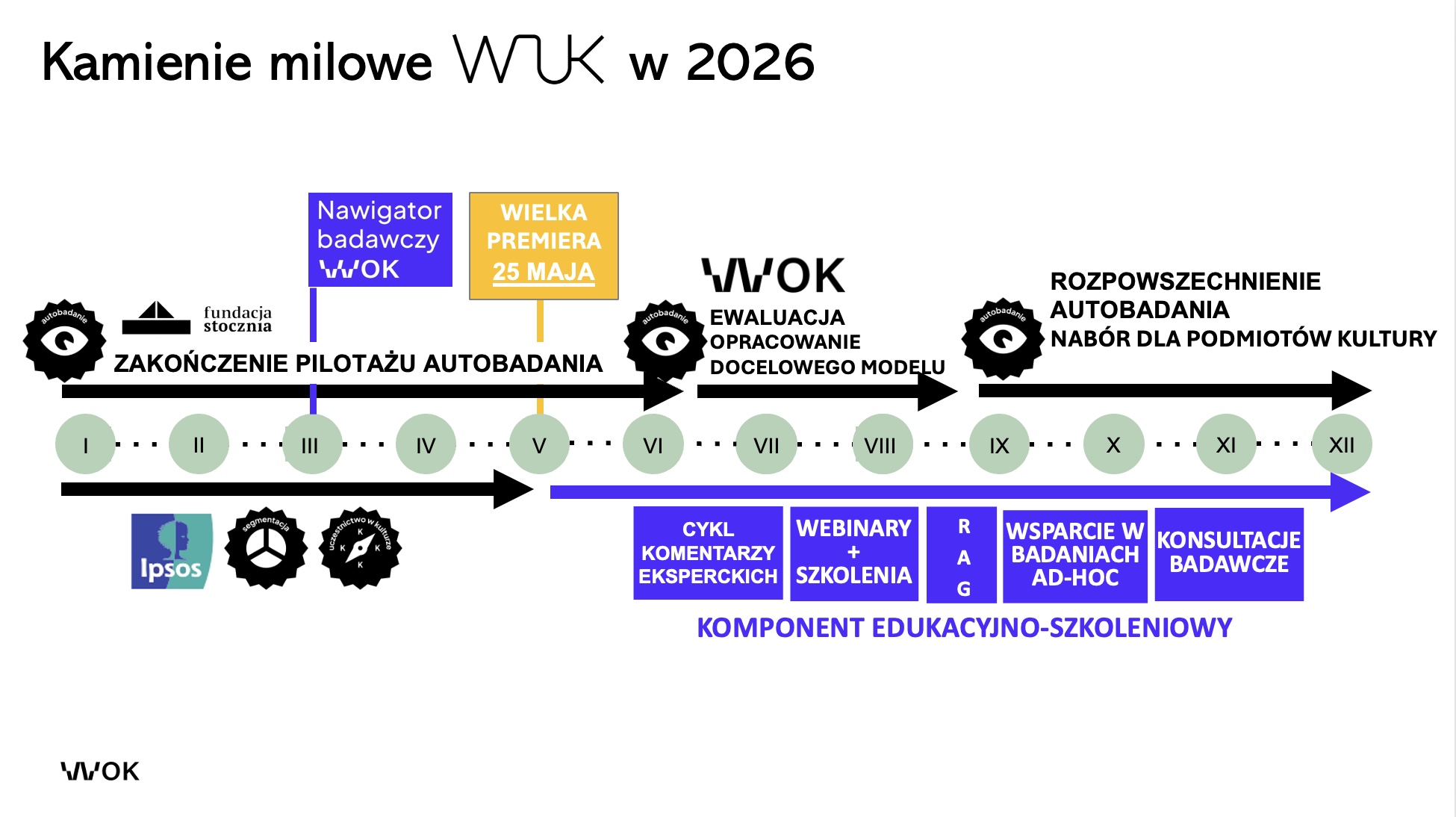
The first is a city-wide survey of 9,000 residents in Warsaw, supplemented by individual and group interviews, which will form the basis for new audience segmentation; this survey will be conducted every three to four years.
The second is self-diagnosis by cultural institutions, repeated annually: each institution will be able to use the same research tool – ultimately compatible with the new segmentation – to collect data on its audiences, which is then sent to WOK to be analysed for individual institutions and for the sector as a whole. In September 2025, we launched the second phase of the self-diagnosis pilot scheme, involving 15 cultural institutions; to date, over 7,000 questionnaires have been collected.
The third is the development of tools that help institutions work with data and gain access to it. These already include the Research Navigator, which supports teams in designing and conducting research by helping them find the necessary tools and resources – available online but often difficult to locate. We believe the Navigator will empower cultural institutions and help them become more self-reliant in their research processes.
In the longer term, following the completion of the segmentation study and the pilot self-diagnosis scheme, we plan to develop a training and support module for teams within cultural institutions. This will help to strengthen their data literacy skills – integrating these into the programming practices and organisational culture of different institutions. At the same time, this will enable us to identify the needs of institutions in terms of developing a data-driven working culture.
More generally, we hope that regularly collected and analysed, comparable data will support local authorities at various levels in developing data-driven policies.
What lies ahead?
“WCP is a system of interconnected vessels. A city-wide segmentation study and systematic self-diagnosis carried out by an increasing number of cultural institutions will provide a comprehensive, nuanced picture of participation (and non-participation) in culture. We also view this process as an opportunity to develop a ‘culture of working with data’ and to enhance the resilience of the cultural sector,” says Małgorzata Bakalarz-Duverger, PhD, director of the Warsaw Observatory of Culture.
We invite you to follow WOK’s media channels, where we will be sharing the results of the WCP research.

People involved in the project:
