



Agata Nowotny
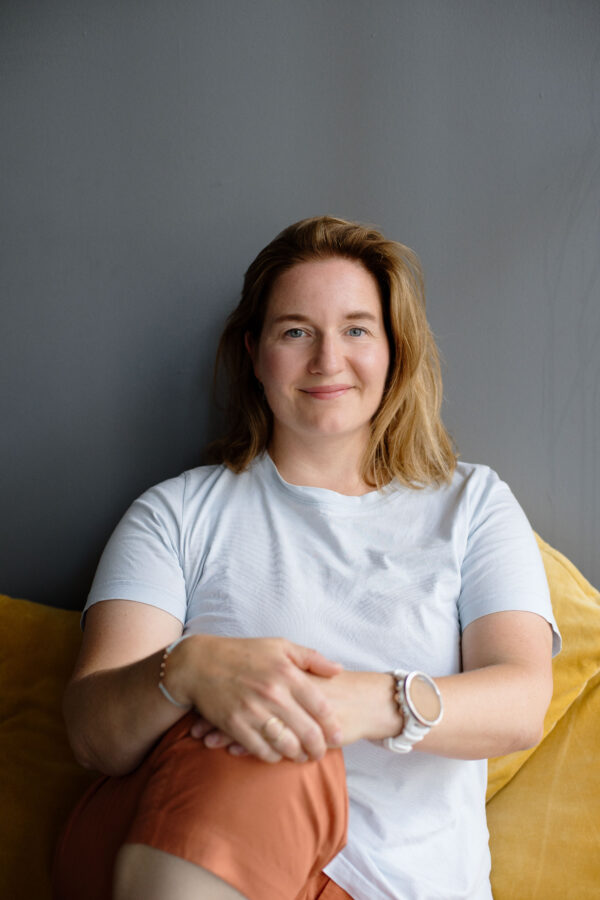
I am going through a period of professional and personal change, which is testing and building my resilience. Two years ago, after the birth of my daughter, I underwent the biggest re-evaluation of my life. Shortly after returning to work, I started to experience symptoms of burnout. This is what prompted me to consider new directions for my personal and professional development. Being a single mother prevented me from making a change for a long time. I was afraid of losing stability. However, motherhood has sharpened my sense of purpose and my need for meaningful work, and has reawakened my creativity. I graduated in sociology. For many years, I worked as a researcher in a cultural NGO. However, I recently realised that working in a corporation was not the right path for me. I miss having a sense of purpose, working with people and having a sense of agency. Drawing on my experience and knowledge, I would like to support others in their creative development and accompany them as a mentor through creative change.
The concept of resilience resonates with me on many levels. To me, it means having resilience without necessarily having strength. It means flexibility, but with a strong sense of rootedness and grounding. It is the ability to adapt while maintaining a strong sense of identity. Ultimately, success is less important than the ability to emerge from crises in a balanced way. This is a key competence in today’s world. Multiple crises are a common experience today, and there are no universal solutions or established patterns that can guarantee peace of mind.
It seems to me that the creative community is particularly vulnerable to turmoil in times of crisis. At the same time, however, I recognise the significant role that creativity can play in fostering resilience and boosting self-confidence.
Put simply, I want to take care of myself. It’s not easy to admit. Women of my generation were socialised to put others first. That is why I am writing this with pride and confidence, knowing that I am at a stage in my life where I must start with myself and devote time to myself if I am to be able to support others.
I am a sociologist by training and have extensive experience in social and commercial research, particularly in design research. I have always had a close relationship with art and culture. My professional activities have spanned various disciplines: I have curated design exhibitions, completed an art coaching course, created a programme and a team of sociologists who lecture at the School of Form art college, collaborated with designers and edited Futu magazine. Today, I feel that I have the knowledge and experience to support others in their development. My strengths lie in supporting people, recognising potential and working with resources. I have been doing this for years, almost incidentally, and I am now ready to build my professional identity around it.
During my residency, I would like to focus on planning my development as a creativity mentor, including finding the right term for it, outlining goals, testing methods and identifying the needs of the environment.
Although I have conducted extensive theoretical research, I am in need of lively discussion, diverse perspectives, an exchange of ideas and inspiration from the experiences of others. Therefore, I would be delighted to meet and discuss with a group of residents. I would gladly take advantage of the opportunity to use the WOK space for meetings and conversations with interested parties in order to test various working models (e.g. group meetings and networking of creative people). I am open to the idea of further training and organising my mentoring skills.
I am an educator, creative development mentor and facilitator. I also work as a service and user experience designer. I am a trained sociologist with many years of research experience, particularly in the field of design. I have had the opportunity to work with NGOs, corporations and small creative teams. Having experienced burnout myself, I am sensitive to the challenges of balancing personal life and professional development, especially in the field of creative work. Today, I help creators develop their creativity, organise their creative work, and find sources of energy.
Agata’s residency is summarised in a journal in the form of a short zine. Each Warsaw Observatory of Culture (WOK) residency has a unique dimension, and the participants’ personal accounts of their experiences reflect this diversity.
Before
I am not sure where to begin, as I struggle to pinpoint the beginning. I think it started with fatigue. It was an increasing, growing fatigue – the kind that wouldn’t go away, leaving me feeling weak. I felt as though my battery was depleted and couldn’t be recharged. Usually, after a bad day comes a better one. When work and life wear you down, you find ways to regenerate and get back into shape. You can sleep in and wake up feeling rested; you can go to the cinema and feel relaxed afterwards; you can have a massage and feel refreshed. However, I reached a point where nothing helped anymore. I didn’t have the strength to organise anything extra, as even the simplest tasks, such as answering the phone, looking at my calendar and choosing a date, overwhelmed me. I reluctantly turned on my computer, where work was waiting for me. A world of work that didn’t understand my burnout. At the time, I didn’t understand it either and didn’t recognise it as such.
Giving it a name
I fell ill because I gave it a name. At least, I think so. I had a bad case of COVID, which kept me down for a long time. Once I had recovered, things were supposed to get better, but they didn’t. I returned to work for a single day. I turned on my computer and attended a long-awaited meeting, but I was nervous because I couldn’t understand anything that was being said. I could hear the words, but I couldn’t grasp their meaning. I was scared because I felt that my mind was failing me. At the time, I didn’t realise that this was actually protecting me. I only realised this later, after three months of sick leave, when I was slowly convincing myself that I deserved time to recover, and that it was possible to live without producing something valuable every day. In other words, I realised that it was possible to live without work yet not lose one’s sense of purpose. My wise doctor told me not to think about work, explaining that this is the purpose of sick leave and that it’s a luxury in adult life. She encouraged me to take advantage of it. She was right.
Slowing down
My leave lasted a total of six months. This is the maximum amount of time you can legally take to recover and rebuild your life in Poland. Interestingly, elsewhere you can do this for two years. At the same time, a good friend of mine from work was going through a similar process, except she lived in the Netherlands and was subject to Dutch law. This allows for a two-year recovery period and a gradual return to work. This process is called reintegration: the Dutch rightly assume that an employee returning to work needs time to readjust to the rhythm and routine of work. And that is not easy.
Many things helped me: ensuring I got enough sleep, spent quality time with my child without worrying about the clock, changing my eating habits, starting supplements, visited a physiotherapist, and exercised regularly. I was accepted to a residency programme focused on resilience.
I quickly realised that, to emerge from my state of mind, I needed to practise resilience. This way, I would be able to become more resilient.
The text of my residency application is the first meaningful piece of writing I have produced in a long time.
I applied
What did I apply with? Nothing. I wrote the truth: that I was in crisis; that I was taking a break from work; and that I wanted to rediscover my values because I had lost them somewhere along the way.
It wasn’t easy to write an application where you’re not supposed to suggest an idea or project. You’re not expected to be productive. Instead, you’re offered space and time. Space to take care of yourself and time – something everyone always lacks. As a result, you can get the breathing space and emptiness that best regenerates you.
Writing such an application is a strange, deeply existential experience. This is because when you write, you realise the most important things.
For me, it was about identity. I felt that this time was a gift and that the residency was a luxury, allowing me to suspend the daily hustle. It was an opportunity to pause and take in the surroundings. Where am I? Who am I? What am I doing? What do I want to do? What do I no longer want to do, and what is not suitable for me?
The beginning
The first few weeks were a slow start-up period. Although we were told that there were no strict requirements, we were asked to keep a journal. It took me several weeks just to choose a notebook. In hindsight, I realise that this was a form of procrastination, but there was a reason behind it.
Thanks to the fact that my time off, burnout and residency overlapped, I was able to safely sink into doing nothing and realise how important rest, regeneration and a change of perspective are. On a deeper level, I experienced a profound sense of emptiness. ‘Get up and see how you sit, is how I would describe that time.
I had been sitting crookedly, straddling several chairs at once and perched on uncomfortable stools rather than comfortable seats.
Ideas
The first ideas began to emerge from this void. Or perhaps it wasn’t a void at all, but an open space? Maybe that’s when I had a clearer idea of what I wanted, what I could offer and what brought me joy and gave me a sense of purpose.
I quickly moved on to taking action. I developed a concept for group development meetings tailored specifically to designers. I sent out invitations and received responses from 20 people. I formed two groups and suggested three dates for them. During the summer holidays, we met in the city centre at the WOK space to discuss ways to boost creativity.
We began the series with a session on regeneration and burnout. These topics turned out to be very necessary, as regardless of how we work, we reach a point where we lose our strength and are unable to regain it. During these sessions, I discovered how difficult it is for people to self-diagnose and how long it takes before we recognise burnout. I understood this because I had recently experienced it myself.
Being there
After several meetings that put me in a state of pure flow – a mindset essential for creativity – I finally felt at home. I knew that I wanted to develop this further. I also knew that I wanted to reinvent.
That’s why I enrolled on a coaching and mentoring course at the Psychoeducation Laboratory. I didn’t go back to my old job; I decided to trust myself and my intuition.
Missing work
I did not miss work. At least, that’s what I thought, until I read the journal I had been keeping since August.
In August, I decided to join a virtual group of people from around the world and follow the process described in The Artist’s Way as an experiment. I overcame my usual scepticism and went with the flow. Week after week, I read another chapter and completed the tasks for each stage. Most importantly, I wrote three pages of text every morning. Every day, right after waking up and following the instructions, I would reach for my notebook and write. Fortunately, you can write about anything, although sometimes even that was challenging. At first, my hand hurt because I was so out of practice. My handwriting was also illegible. I would like to write more neatly.
Then I had to explain to my three-year-old daughter that I was writing down important things and that I wouldn’t be able to answer all her questions. Fortunately, three-year-olds learn and adapt quickly. My daughter started bringing her own notebook and scribbling in it. Recently, she drew her first self-portrait, which moved me deeply.
Writing these three pages also turned out to be a kind of self-portrait – after reading them, I feel as though I have met myself again. It was an interesting encounter.
Today
A new podcast has just been released in which Anna Sańczuk and I discuss my experiences and journey. Entitled Jak Ona To Robi (How She Does It), I invited myself onto the show by asking the host, ‘Ania, let’s talk about how she doesn’t do it!’ I firmly believe that the act of not doing things is something that warrants discussion. Not doing things opens us up and allows us to view life from different perspectives.
Today is also the end of the residency. I have another session with our development group in two days. Following the pilot in July, some participants expressed interest in continuing the meetings. That’s why I created a three-month plan: we meet every two weeks to talk, exercise and exchange experiences. The girls themselves called it a ‘creative village’. I am grateful to them for their trust and for our beautiful collaboration.
I dedicate this text to them – my creative village. It is dedicated to the women who have actively nurtured their creativity, resources, and creative energy, and have embraced new approaches to work and communication.
After
I think I can safely say that I am settling down on the sofa. I have regained my sense of perspective and comfort, as well as my confidence that I am in the right place. I also have the freedom to get up and go after what I need. I no longer adopt impossible positions. I am grounded, my mind is clear, and I feel enthusiastic about new endeavours. My new plans, ideas and projects are not spectacularly innovative, but they integrate and connect many of the things I love and excel at.