



Marcin Liminowicz
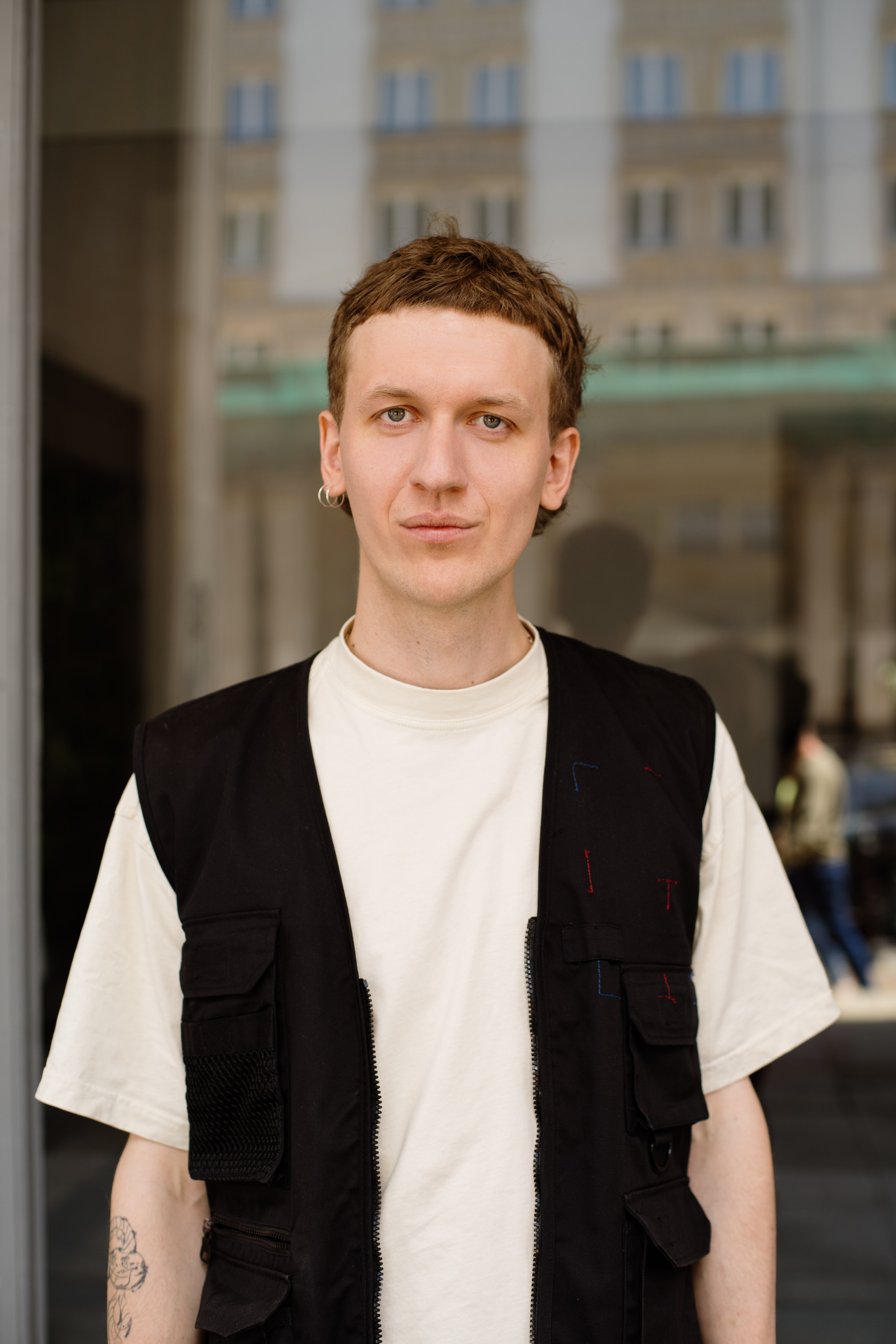
As a freelancer, I often prioritise exhausting care work over artistic activity. I want to use the residency to strengthen the areas of my practice that need the most attention, and develop a more balanced plan of action, both artistic and professional. With the support of WOK, I would like to break this pattern, deepen my ability to observe and analyse dog behaviour, and make real progress in my research and artistic work.
I am a video artist, researcher and graphic designer. I graduated from the Non-Linear Narrative programme at the Royal Academy of Art in The Hague, and I have also studied photography in Opava in Czechia and film production at the Łódź Film School. I was a scholarship holder at the Fabrica research and design centre in Italy. In my work, I combine the aesthetics of visual essays with field research and speculative techniques. Currently, I am exploring the relationships between humans and animals within the contexts of culture, domestication and care. I volunteer at an animal shelter, where I explore interspecies coexistence practices. Alongside Jakub Depczyński, I curated the experimental film review More-Than-Human Gaze at the Museum of Modern Art in Warsaw. I co-founded the Spółdzielnia Krzak collective and the Krzak Papier magazine in the past. I took part in the 9th edition of VISIO – the European Programme on Artists’ Moving Images – as part of the Lo Schermo dell’Arte festival. My work is included in the collections of the Musée de l’Elysée in Lausanne and the Polyeco Contemporary Art Initiative in Athens.
Marcin’s residency is summarised in a journal in the form of a short zine. Each Warsaw Observatory of Culture (WOK) residency has a unique dimension, and the participants’ personal accounts of their experiences reflect this diversity.
Excerpts from a Diary
For a long time, I have combined several roles and modes of activity in my practice, including design and graphic work, research, art, and dog care. I used to see this diversity as a problem and a source of inconsistency. I felt that my work across multiple fields was fragmented and lacked clear direction.
When I began my residency at WOK, I felt the need to organise these areas of my practice and find a common denominator. Initially, I thought that further work with dogs would require an entire professional shift, necessitating formal training and the abandonment of some of my previous artistic practice. However, during the residency, my thinking gradually shifted. Rather than striving for reduction and selection, I began to recognise the value of the patchwork, parallelism, multiplicity and mutual reinforcement inherent in these modes of operation.
The residency supported me in several ways, enabling me to combine areas seamlessly without having to prioritise one over the other. I was able to devote more time to research and reading. I organised my theoretical references and anchored my interests in interspecies relations and the animal perspective more firmly.
Concurrently, I significantly deepened my practical work with dogs. I took part in a challenging adoption process, went on numerous socialisation walks and developed a deeper understanding of my dogs. These experiences allowed me to translate theoretical reflection into sustainable everyday actions and confront the concepts of care, dependence and agency with the real needs of animals.
Specific achievements were also made. Thanks to the funding and support from the residency, I was able to attend a seminar led by Filipa Ramos at the Institute for Postnatural Studies. I undertook individual training with a behaviourist and dog trainer. These experiences helped me clarify how I balance art, research and care practice, and sketch out long-term plans, such as creating my own space for care, observation and relational work in the future (a preliminary idea being a dog hotel).
I also dedicated the residency period to conceptual work and writing grant and scholarship applications. I obtained funding to continue working on the film, which allowed me to conclude this process with a strong sense of continuity and reinforcement.
Below are some excerpts and thoughts from my residency:
- A sonogram of a so-called ‘lost call’ – the vocalisation of a newborn puppy. It is a distress signal that is energetically costly and only present in the early stages of life. The image from the book How Dogs Work by Raymond Coppinger and Mark Feinstein kept coming back to me as a point of reference when thinking about resilience.
- Enfleshed Ecologies: Ecologies of Entities and Beings – cover. Animal / stone / shaman.
- Atliszka and a roll from a garbage bin. Protection of resources: postural tension, controlling gaze.
- Return with Donna from the pre-adoption visit.
- Institute for Postnatural Studies – For, Against, After, Towards – Architecture Beyond the Human seminar led by Filipa Ramos.
- Individual training with a behaviourist – muzzle and touch training.
- Rio and Zola. Petsitting in Kępa Oborska. Care as a practice and planning my own space.
- Ball dog and cube dog – the same volume, the same number of cells, different forms and converse behaviours. A drawing from Peter Pinardi’s book How Dogs Work by Raymond Coppinger and Mark Feinstein. A reference point for thinking about the relationship between shape, the environment and behaviour.


Poniżej kilka wycinków i wspomnień z tego czasu:
- Sonogram tzw. lost call – wokalizacji nowo narodzonego szczeniaka. Jest to sygnał dystresu, energetycznie kosztowny i obecny tylko na wczesnym etapie życia. Obraz z książki How Dogs Work autorstwa Raymonda Coppingera i Mark Feinsteina wracał do mnie jako punkt odniesienia w myśleniu o rezyliencji.
- Enfleshed Ecologies: Ecologies of Entities and Beings – okładka. Zwierzę / kamień / szaman.
- Atliszka i bułka ze śmietnika. Obrona zasobów: napięcie posturalne, kontrolujący wzrok.
- Powrót z Donną po wizycie adopcyjnej.
- Institute for Postnatural Studies – seminarium For, Against, After, Towards – Architecture Beyond the Human, prowadzenie: Filipa Ramos.
- Indywidualne szkolenie z behawiorystką – trening kagańca i dotyku.
- Rio i Zola. Petsitting na Kępie Oborskiej. Opieka jako praktyka i planowanie własnego miejsca.
- Ball dog i cube dog – ta sama objętość, ta sama liczba komórek, różne formy i odmienne zachowania. Rysunek Petera Pinardiego z książki How Dogs Work autorstwa Raymonda Coppingera i Marka Feinsteina. Punkt odniesienia w myśleniu o relacji między kształtem, środowiskiem i zachowaniem.