



Helena Łomnicka
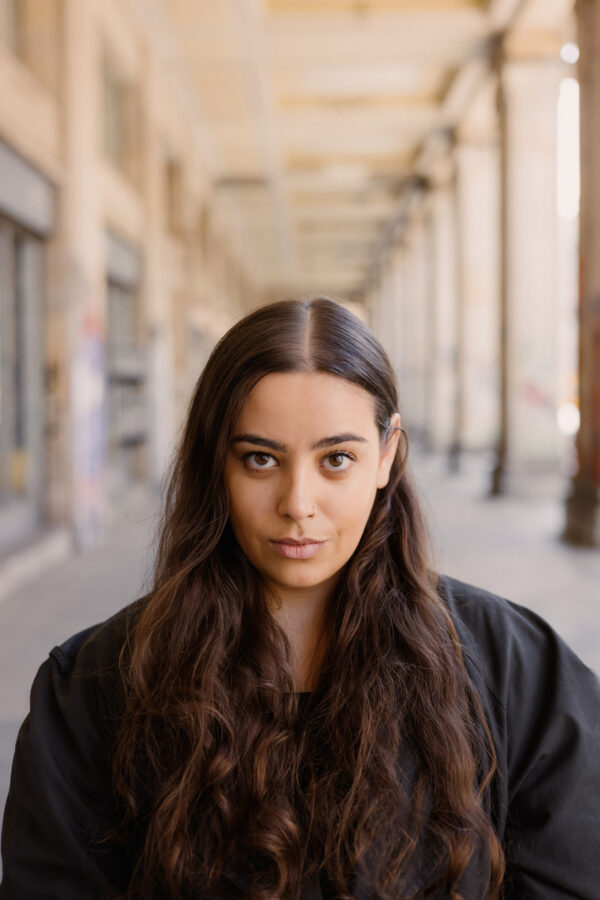
I applied for the programme a few months after moving back to Warsaw, having spent almost ten years living abroad. As I built most of my career outside Poland, the local scene feels quite alien to me today. The lack of an extensive network of contacts means I find myself in a state of limbo ‘in between’, and I feel that my experience needs to be renegotiated so that I can re-establish myself in the local context and find my place in Warsaw for the long term.
I view the WOK residency as a laboratory for this change: a space to simply be ‘here and now’ for a moment, rather than letting one’s thoughts race anxiously ahead to the future, as well as an opportunity to build relationships and perhaps slightly redefine working methods.
As an independent researcher of contemporary spirituality, I often refer to the concept of ‘equality of knowledge’. I strive to treat esoteric and mystical knowledge on a par with scientific knowledge – for me, this is a prerequisite for researching these fields with due respect. During my residency – in the spirit of this year’s theme – I would like to reflect more deeply on what this equality means in practice. I used to be very keen on extending my theoretical propositions to experimental research methods, but I feel that over the years I have had to start opting for more tried-and-tested choices, as these stood up best in the eyes of grant-awarding bodies.
I would like to use this time and support of WOK to re-examine how my research methods can reflect an attempt to de-hierarchise structures of knowledge and function as a concrete research-artistic practice, rather than merely a theoretical proposition. I hope that this experiment will allow me to rethink the foundations of my work and regain a sense of professional agency, and above all, to find stable ground for my future personal and professional endeavours in Poland.
I am an independent researcher focused on the analysis of contemporary spirituality and its intersections with modern politics and visual culture. I hold a degree in cultural studies as well as an MA in the History of Esotericism, obtained as part of a program led by the Center for the History of Hermetic Philosophy and Related Currents in Amsterdam.
In the last years my research has focused on neo-Marxist perspectives on spirituality, as well as on the analysis of contemporary esoteric discourse in digital culture. I have lectured on these and related topics in academic and cultural contexts, including at Willem de Kooning Academy (2022), Post-Office Amsterdam (2025), and on Radio Kapitał (2025).
In my work I seek to foreground alternative forms of knowledge and to examine the enduring presence of spiritual belief, myth, and magic in the contemporary world. In 2026, I am collaborating with Romanian visual artist and researcher Dorin Budușan on a new research project focused on the analysis of historical and contemporary vampiric references in the construction of Western narratives about Eastern Europe, as well as the geopolitical identities that emerge from this process.
Residency summary
I applied to the WOK residency looking for support with two different kinds of homecoming. The first, more personal and geographic, concerned my move back to Poland. The second, professional, was about wanting to return to a way of working that would leave room to test new approaches in my research.
The first homecoming
During the residency, although often only in the background, a great deal actually happened. WOK was with me not only through the initial move to Warsaw and tying up the last loose ends of leaving the Netherlands, but also through a second move, this time within Warsaw itself. Somewhere between the two, I learned to approach the city itself with humility — to look at it with curiosity and understanding, to keep reminding myself that I need to get to know this place anew, which would certainly take time and won’t resolve into a clear-cut sense of belonging within three months.
The group of fellow residents turned out to be an enormous resource — during our meetings we shared a whole range of personal experiences and stories. And although we were very different, it often turned out that we shared similar experiences, and a sense of belonging — geographic, personal, or professional — was a constantly recurring theme.
The second homecoming
In my residency application, I mentioned that experimentation had come to feel like a luxury — a chance to allow myself real enthusiasm, which I’d lost somewhere along the way after finishing my studies. In seeking stability, I would sometimes subconsciously choose to draw on the bare minimum of creative resources — often opting for tried-and-tested solutions to maximize the number of projects and commissions I could take on. In this way I was burning myself out: losing the spark and the joy of work I truly love.
During the residency I went to a place in Kurpie for a week, where I returned to exploring the methodology of lived religion: it is a form of research into spirituality grounded in explorations on how faith/religion functions in everyday life. Watching how quickly that long-lost joy came back to me was heartening. I regained this joy because I had a guaranteed working space and the chance to focus, for a while, on the continuity of my own thinking. I also received financial support from WOK as a part of the residency program. It’s hard to reach that state of focus in everyday life when one is juggling several jobs at once. The residency helped me understand the direction I’d like to move in. I’m finishing the residency with the sense that I’m ready to reconnect with my roots.
On the geographic question, the decision has already been made — even if only for now — but I’d like to approach this change calmly and give myself time to see what it brings. As for the professional dilemma, during the residency I came to realize that the gaps I often felt in the academic environment were ones I’d tried to fill by chasing interdisciplinary approaches, drawing on artistic methods, and especially on collaborations with artists. Now, though, I see that my basic and natural way of working lies elsewhere — in the end, it’s traditional academic methods that let me tap into real enthusiasm and joy.
That’s why I’m leaving the residency aware that my direction in spirituality research requires me to look for methodologies that suit me not outside academic-research structures, but within them. In this context, lived religion is exactly the direction I’d like to keep pursuing — particularly through the research I’m now interested in on Poles who identify as spiritual but not religious.